



Search
- Page Path
- HOME > Search
Case Reports
- Primary Bladder and Ureteral Amyloidosis Initially Diagnosed as Chronic Cystitis: A Case Report
- Seungsoo Lee, Dan Bee Lee, Hyun Jung Lee, Won Hoon Song, Sung-Woo Park, Jong Kil Nam
- Urogenit Tract Infect 2025;20(3):167-172. Published online December 31, 2025
- DOI: https://doi.org/10.14777/uti.2550038019
-
 Abstract
 PDF
PDF PubReader
 ePub
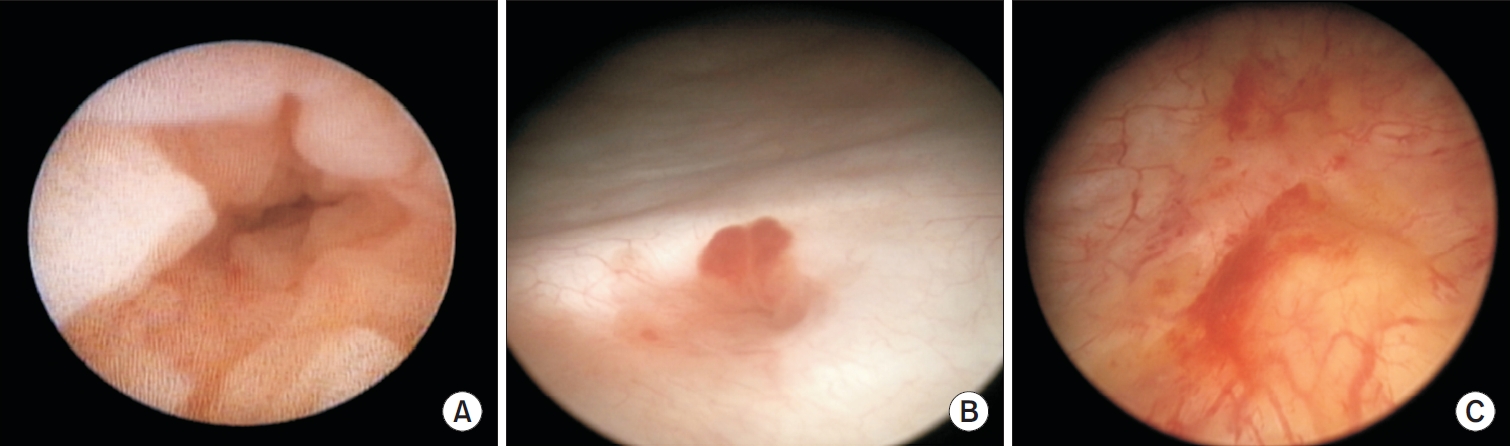
ePub - Primary localized amyloidosis confined to the urinary tract is uncommon and frequently misinterpreted due to clinical and radiologic overlap with more prevalent conditions. We describe a 69-year-old woman who experienced recurrent gross hematuria over 2 years and underwent initial transurethral resection based on a presumptive diagnosis of chronic cystitis. Subsequent evaluation revealed a left ureteral mass with hydronephrosis, raising concern for malignancy. Histopathologic examination of both bladder and ureteral specimens demonstrated amorphous eosinophilic deposits that stained positive with Congo red and showed apple-green birefringence under polarized microscopy. Immunofluorescence confirmed λ-light-chain predominance, establishing AL (amyloid light chain)-type amyloidosis without systemic involvement. The patient underwent complete endoscopic resection and remains asymptomatic during ongoing surveillance. This case highlights the diagnostic challenges posed by localized urinary amyloidosis and underscores the importance of histologic confirmation in atypical inflammatory lesions.
-
Citations
Citations to this article as recorded by
- Primary Localized Amyloidosis of the Urinary Bladder Mimicking Urothelial Carcinoma: A Case Report
Gassan M Salih, Saad Masood, Filip Kondylis
Cureus.2026;[Epub] CrossRef
- Primary Localized Amyloidosis of the Urinary Bladder Mimicking Urothelial Carcinoma: A Case Report
- 3,182 View
- 20 Download
- 1 Crossref

- Spontaneous Bladder Perforation in a Patient with a Long-Term Intraurethral Catheter
- Taegi Choi, Hyunkyung Lee, Junseok Kim, Sunghoon Lee, Younkyung Cho, Eunyoung Kang, Jinsun Kang, Sumin Lee, Eunju Na
- Urogenit Tract Infect 2023;18(3):110-113. Published online December 31, 2023
- DOI: https://doi.org/10.14777/uti.2023.18.3.110
-
Abstract
PDFPubReaderePub
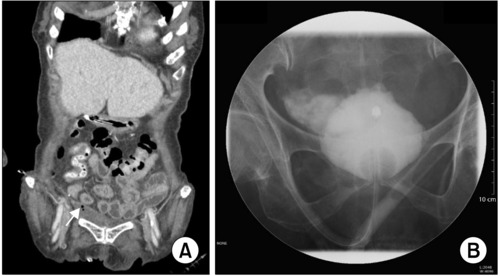
- Urinary catheters are commonly used to address various urinary problems. However, the catheter itself can be a cause of several complications, including catheter-associated urinary tract infections, damage to the bladder and kidneys, and, in extremely rare cases, bladder perforation. We present a case of spontaneous bladder perforation in a patient who had a long-term indwelling intraurethral catheter. The patient with prior hypoxic brain damage suddenly developed tachypnea, tachycardia, and oxygen desaturation. Computed tomography and retrograde cystography revealed an extraperitoneal bladder perforation with an intra-pelvic abscess. Antibiotics were prescribed and a urinary catheter was inserted for drainage. After 11 weeks, the abscess resolved, and the catheter was removed to enable self-voiding. The perforation was attributed to chronic inflammation and distension of the bladder wall caused by the intraurethral catheter. Given the potential complications associated with long-term urinary catheterization, the timely removal of indwelling catheters should be considered.
- 9,174 View
- 22 Download
Original Article
- Exploring National Trends in Bladder-Related Urological Procedures: A Nationwide Population-Based Cohort Study
- Hyosang Kwon, Wonjong Yang, Sangyong Park, Heesub Lee, Jong Keun Kim, Jun Hyun Han
- Urogenit Tract Infect 2023;18(2):50-59. Published online August 31, 2023
- DOI: https://doi.org/10.14777/uti.2023.18.2.50
-
Abstract
PDFPubReaderePub
- Purpose: This study examined the epidemiological trends of bladder-related urological procedures in South Korea from 2009 to 2021.
Materials and Methods: The data were obtained from the Health Insurance Review and Assessment Service (HIRA) database, encompassing various bladder-related urological procedures. The frequencies and trends were analyzed using statistical methods.
Results: Uroflowmetry, cystoscopy, prostate biopsy, and urethral dilation showed a positive trend, while prostate massage exhibited a negative trend. The 72-hour voiding function test, which started in 2017, also demonstrated a positive trend in frequency. A urodynamic study and mid-urethral sling operation exhibited an overall decreasing trend. Bladder-indwelling catheter, Nelaton catheterization, and cystostomy catheter change showed increasing trends, while suprapubic cystostomy showed a decreasing trend.
Conclusions: This 12-year analysis provided valuable insights into the epidemiological patterns and utilization of bladder-related urological procedures in South Korea. These trends highlight the evolving landscape of diagnostic and therapeutic approaches in bladder-related conditions and the importance of interdisciplinary collaboration between urology and other medical departments. The results highlight the need for optimizing catheter-related care protocols, resource allocation, and continued monitoring of practices across healthcare settings. -
Citations
Citations to this article as recorded by- Screening for Asymptomatic Bacteriuria Before Cystoscopy: A Systematic Review and Meta-analysis
Patrick G. Rice, Robyn S.E. Hawkins, Bhaskar K. Somani
European Urology Focus.2026;[Epub] CrossRef
- Screening for Asymptomatic Bacteriuria Before Cystoscopy: A Systematic Review and Meta-analysis
- 3,753 View
- 13 Download
- 1 Crossref
 First
First Prev
Prev


