


Search
- Page Path
- HOME > Search
Case Reports
- Bilateral Xanthogranulomatous Pyelonephritis With Extensive Abscess Associated With Neurogenic Bladder: A Case Report
- Sin Woo Lee, Hee Seung Choi
- Urogenit Tract Infect 2026;21(1):40-43. Published online April 30, 2026
- DOI: https://doi.org/10.14777/uti.2550026013
-
 Abstract
 PDF
PDF PubReader
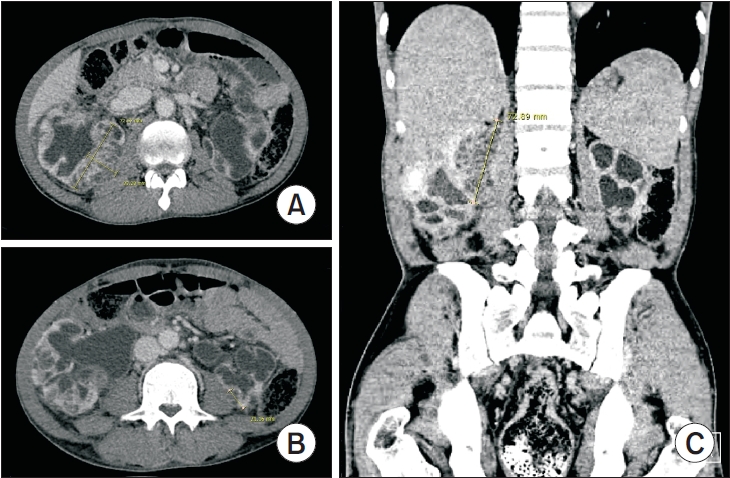
 - Xanthogranulomatous pyelonephritis (XGP) is a rare and severe form of chronic pyelonephritis. We report a case of bilateral XGP complicated by extensive abscess formation. A 47-year-old man presented with fatigue and generalized weakness. Laboratory evaluation revealed leukocytosis and elevated serum creatinine levels. Urinalysis demonstrated pyuria and bacteriuria. Computed tomography (CT) revealed bilaterally enlarged kidneys with multifocal renal parenchymal and perirenal abscesses. The CT scan also demonstrated severe bilateral hydronephroureter and diffuse bladder wall thickening, with a radiologic impression of severe pyelonephritis with abscess formation and neurogenic bladder. The patient was admitted and treated with intravenous antibiotics and percutaneous nephrostomy tube placement. However, no clinical improvement was observed with conservative management. The patient subsequently underwent right open radical nephrectomy. Histopathological examination confirmed the diagnosis of XGP with extensive abscess formation. The patient experienced no further complications or recurrence after surgery. This case suggests that chronic untreated neurogenic bladder may contribute to the development of severe chronic pyelonephritis such as XGP.
- 1,013 View
- 19 Download

- Xanthogranulomatous Epididymitis Unresponsive to Antibiotic Treatment
- Yeasol Kwon, Jun Baek Park, Sang Hwa Lee, Seung Ki Min
- Urogenit Tract Infect 2023;18(2):70-73. Published online August 31, 2023
- DOI: https://doi.org/10.14777/uti.2023.18.2.70
-
Abstract
PDFPubReader
 ePub
ePub - Xanthogranulomatous epididymitis is very rare, and there are few case reports worldwide. Clinically, it is necessary to differentiate between chronic scrotal inflammatory diseases, such as tuberculous epididymitis and testicular tumors. Proteus and Escherichia coli are the pathogens that generally cause xanthogranulomatous pyelonephritis, but the pathogens of xanthogranulomatous epididymitis are unclear. This paper reports a case of a 66-year-old male with epididymitis on scrotal ultrasonography and had Pseudomonas aeruginosa detected in a culture test. An orchiectomy was performed because he did not respond to antibiotic treatment.
- 5,255 View
- 22 Download
 First
First Prev
Prev


