



Search
- Page Path
- HOME > Search
Original Article
- Role of Presepsin as a Predictive Factor for Sepsis in Patients With Urinary Tract Infection Associated With Ureteral Calculi: A Retrospective Cohort Study
- Jong Gyun Ha, Hee Chang Jung, Yeong Uk Kim
- Urogenit Tract Infect 2026;21(2):89-95. Published online August 31, 2026
- DOI: https://doi.org/10.14777/uti.2652014.007
-
 Abstract
 PDF
PDF PubReader
 ePub
ePub - Purpose
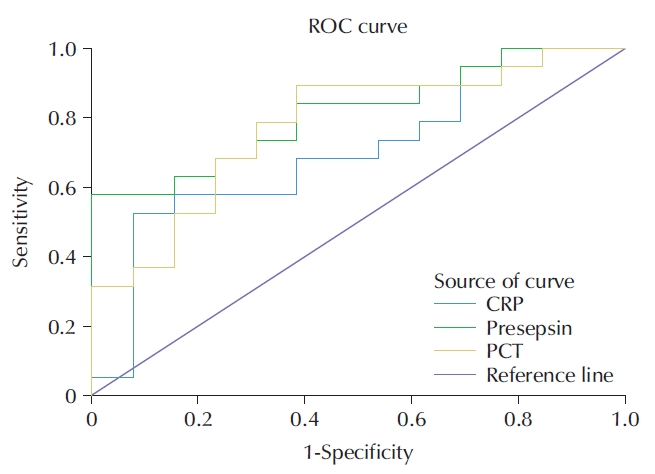
Recently, multiple studies have reported presepsin as a useful inflammatory biomarker for early sepsis diagnosis in patients with urinary tract infections (UTIs). Nonetheless, few studies have evaluated the efficacy of presepsin in urosepsis associated with ureteral calculi. We retrospectively investigated the efficacy of presepsin for early urosepsis diagnosis associated with ureteral calculi. Materials and Methods: Between May 2021 and July 2023, 64 patients with UTI associated with ureteral calculi were included. Sepsis was defined as a Sequential Organ Failure Assessment (SOFA) score increase of ≥2 points. Patients were divided into 2 groups, with (n=38) and without (n=26) sepsis, and we assessed clinical characteristics (age, sex, and past medical history), laboratory data, and stone characteristics. Additionally, we evaluated predictive factors for urosepsis associated with ureteral calculi and compared these factors with inflammatory biomarkers.
Results
The proportion of females in the sepsis and nonsepsis groups was 89.5% (n=34) and 61.5% (n=16), respectively. In univariable analysis, low albumin level, low platelet count, and presepsin and procalcitonin (PCT) levels correlated with sepsis (p<0.05). In univariable logistic regression analysis, quick SOFA (odds ratio [OR], 2.071; p=0.033), C-reactive protein (CRP; OR, 1.08; p=0.01), PCT (OR, 1.025; p=0.008), and presepsin (OR, 1.354; p=0.001) were significantly associated with sepsis. In multivariate logistic regression analysis, presepsin (OR, 1.321; p=0.003) was significantly associated with sepsis. In receiver operating characteristic curve analysis of inflammatory markers, the areas under the curve for CRP, PCT, and presepsin were 0.704, 0.777, and 0.814, respectively.
Conclusions
Elevated presepsin levels may help predict sepsis occurrence in patients with UTI associated with ureteral calculi, thereby supporting timely and appropriate intervention.
- 242 View
- 5 Download

Review Article
- Antibiotic Prophylaxis for Transrectal Prostate Biopsy
- Do Gyeong Lim, Seung Il Jung
- Urogenit Tract Infect 2026;21(2):47-55. Published online August 31, 2026
- DOI: https://doi.org/10.14777/uti.2652012.006
-
Abstract
PDFPubReaderePub
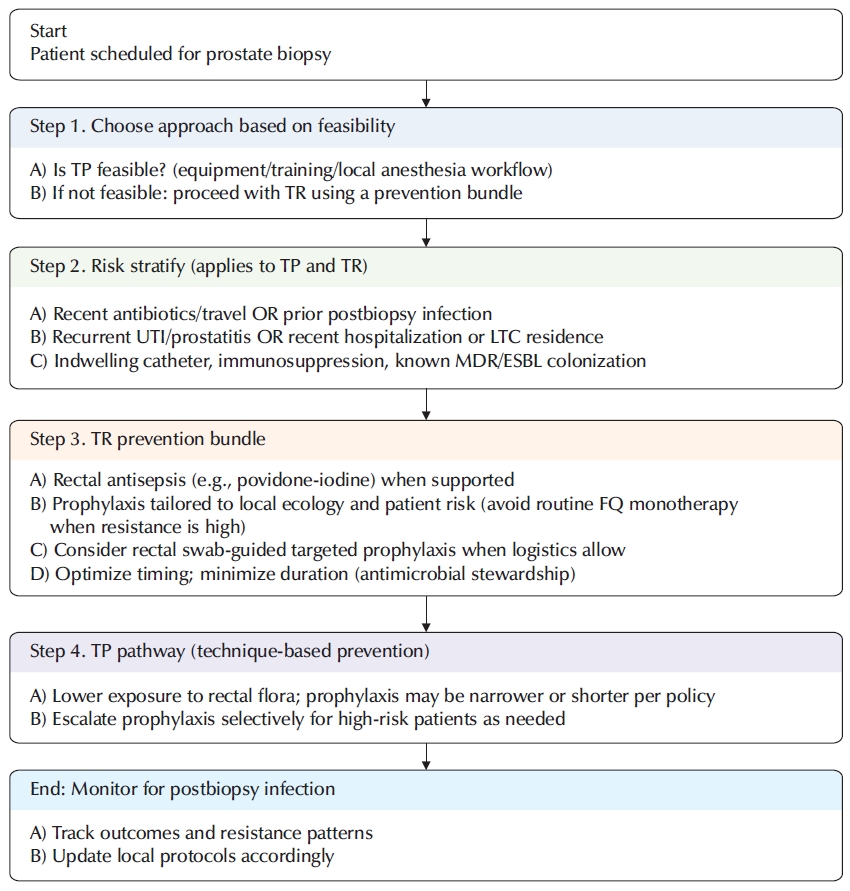
- Transrectal prostate biopsy (TRPB) is widely used for the diagnosis of prostate cancer but carries a clinically meaningful risk of infectious complications due to inoculation and translocation of rectal flora into the urinary tract and bloodstream. Antibiotic prophylaxis remains central to preventing febrile urinary tract infection and sepsis; however, increasing antimicrobial resistance—particularly fluoroquinolone-resistant Enterobacterales—has reduced the reliability of conventional empirical regimens in many regions. In this narrative review, we searched PubMed/MEDLINE, Embase, and Scopus for relevant literature published through February 2026 and synthesized current guideline positions and selected clinical evidence on prophylactic regimens, resistance-adapted regimen selection, and adjunctive measures for TRPB. Cumulative evidence indicates that the efficacy of fluoroquinolone monotherapy has significantly declined in regions with high-resistance prevalence. Alternative or augmented strategies (e.g., cephalosporin- or fosfomycin-based approaches) may reduce infectious complications in selected settings, although their performance appears context-dependent and may be accompanied by shifts in pathogen distribution. Rectal swab-guided targeted prophylaxis can individualize antibiotic selection; however, its effectiveness varies across studies because of methodological heterogeneity and imperfect prediction of clinical outcomes. Technique-based prevention, most notably transperineal biopsy, may reduce infectious risk while decreasing reliance on broad-spectrum prophylaxis. Taken together, infection prevention after prostate biopsy should be individualized according to local susceptibility patterns and patient-level risk while integrating antimicrobial stewardship and selecting adjunctive or technique-based measures when feasible.
- 281 View
- 7 Download
Original Articles
- Impact of the Timing of Percutaneous Nephrostomy on the Prognosis of Obstructive Urolithiasis With Sepsis: A Retrospective Cohort Study
- Ji Eun Yu, Hyung Joon Kim, Hong Wook Kim, Young Seop Chang, Jin Bum Kim, Dong Hoon Koh
- Urogenit Tract Infect 2024;19(3):89-96. Published online December 31, 2024
- DOI: https://doi.org/10.14777/uti.2448018009
-
Abstract
PDFPubReaderePub
- Purpose
The aim of this study was to investigate the prognostic impact of time to percutaneous nephrostomy (PCN) insertion on obstructive ureteral stones with sepsis. Materials and Methods: Data were collected on patients who presented at our Emergency Department between 2017 and 2021 with obstructive uropathy due to urinary stones and underwent PCN insertion. Patients were stratified into 4 groups in accordance with the quick sepsis-related organ failure (qSOFA) score at presentation (<2 or ≥2) and time to PCN insertion (<4 hours or ≥4 hours) as follows: group 1, qSOFA < 2 and time to PCN insertion < 4 hours; group 2, qSOFA < 2 and time to PCN insertion ≥ 4 hours; group 3, qSOFA ≥ 2 and time to PCN insertion < 4 hours; group 4, qSOFA ≥ 2 and time to PCN insertion ≥ 4 hours. The prognostic impacts of the time to PCN insertion were compared between these groups
Results
The total cohort consisted of 96 patients, of whom 70 were classified as either group 1 or 2 (qSOFA < 2). Overall, 37 patients had a positive urine culture. The median time to PCN insertion was 218 minutes, and the median length of stay was 14 days. The hospitalization period was significantly shorter in group 3 than in group 4 (p=0.041).
Conclusions
A shorter length of stay was associated with more rapid PCN insertion in patients with obstructive uropathy and a high risk of sepsis. -
Citations
Citations to this article as recorded by
- Clinical Characteristics, Microbiological Spectrum, Biomarkers, and Imaging Insights in Acute Pyelonephritis and Its Complicated Forms—A Systematic Review
Marius-Costin Chițu, Teodor Salmen, Paula-Roxana Răducanu, Carmen-Marina Pălimariu, Bianca-Margareta Salmen, Anca Pantea Stoian, Viorel Jinga, Dan Liviu Dorel Mischianu
Medicina.2026; 62(1): 222. CrossRef - Early urinary decompression and mortality in septic obstructing ureteral stones: a nationwide comparative-effectiveness study
Mohamed Mahmoud Dogha, Atef A. Hassan, Osama Mostafa Mohamed, Mahmoud Farag, Islam S. Nouh, Mohamed Hamdy Ibrahim, Assem Abdelaziz Mesbah, Mohamed F. Elebiary, Nader A Abdelkhalek, Adel Moalwi
BMC Urology.2026;[Epub] CrossRef
- Clinical Characteristics, Microbiological Spectrum, Biomarkers, and Imaging Insights in Acute Pyelonephritis and Its Complicated Forms—A Systematic Review
- 7,160 View
- 57 Download
- 2 Crossref
- Risk Factors for Sepsis after Retrograde Intrarenal Surgery: Single Center Experience
- Jinseok Kang, Koo Han Yoo, Taesoo Choi, Gyeong Eun Min, Dong-Gi Lee, Hyung-Lae Lee, Jeonghyouk Choi
- Urogenit Tract Infect 2023;18(3):93-100. Published online December 31, 2023
- DOI: https://doi.org/10.14777/uti.2023.18.3.93
-
Abstract
PDFPubReaderePub
- Purpose: To evaluate risk factors for sepsis after retrograde intrarenal surgery for treatment of renal stones.
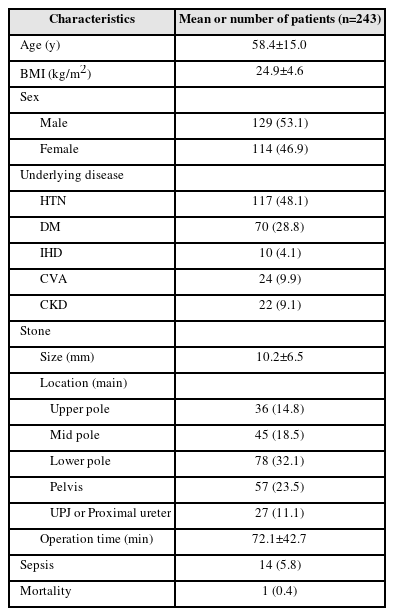
Materials and Methods: We analyzed the clinical data of 243 patients with kidney stones who visited our institution between April 2017 and April 2023. Age, sex, body mass index, underlying disease, location and size of stones, previous history of stones, previous history of urinary tract infections, duration of surgery, preoperative drainage, application of ureteral balloon dilation, and laboratory test results were included in the analysis.
Results: The mean age of the patients was 58.4 (±15.0) years; there were more men (53.1%) than women (46.9%). Of the 243 patients, the overall rate of sepsis was 5.8% (n=14) and the total mortality rate was 0.4% (n=1). In univariate analysis, history of urinary tract infection (p=0.019), positive preoperative urine culture test (p=0.009), operative duration of more than 90 min (p=0.004), and application of ureter balloon dilation (p=0.016) were statistically significant. In multivariate analysis, positive finding in the urine culture test performed before surgery (p=0.003), operation duration >90 min (p=0.005), and use of balloon dilation during surgery (p=0.011) were statistically significant.
Conclusions: There is a risk of progression to postoperative sepsis if bacteria are detected in the urine culture before surgery, if the operative time exceeds 90 min, or if balloon dilation is performed during surgery. Given that the probability of progression to sepsis is approximately 6%, close observation and active treatment are needed for patients with these risk factors. -
Citations
Citations to this article as recorded by- Establishing an AI-based artifact correction system for intrarenal pressure monitoring using the LithoVue™ Elite ureteroscope: an EAU endourology and AUSET collaboration
Takahiro Yanase, Shuzo Hamamoto, Rei Unno, Steffi Kar Kei Yuen, Vineet Gauhar, Bhaskar K. Somani, Olivier Traxer, Yuya Sasaki, Ryosuke Chaya, Atsushi Okada, Kazumi Taguchi, Takahiro Yasui
World Journal of Urology.2025;[Epub] CrossRef - Analysis of postoperative infection factors of retrograde intrarenal surgery combined with negative pressure equipment for renal stones
Deheng Cui, Qinghong Ma, Qiuyan Zhang, Lian Zhang, Guoqiang Chen
Scientific Reports.2024;[Epub] CrossRef
- Establishing an AI-based artifact correction system for intrarenal pressure monitoring using the LithoVue™ Elite ureteroscope: an EAU endourology and AUSET collaboration
- 7,582 View
- 101 Download
- 2 Crossref
Review
- Antimicrobial Therapy and Antimicrobial Stewardship in Urosepsis
- Tae Hoon Oh
- Urogenit Tract Infect 2023;18(1):15-19. Published online April 30, 2023
- DOI: https://doi.org/10.14777/uti.2023.18.1.15
-
Abstract
PDFPubReaderePub
- Since the latest knowledge on the treatment and countermeasures for sepsis is being updated at a rapid pace, becoming familiar with the Surviving Sepsis guidelines is helpful for patient prognosis. Extended-spectrum beta-lactamases (ESBL) are important factors when selecting early empirical antibiotics for sepsis caused by urinary tract infections. For severe septic shock, prolonged infusion and combination therapy need to be considered.
- 7,251 View
- 72 Download
 First
First Prev
Prev


