



Search
- Page Path
- HOME > Search
Original Article
- Prevalence and Epidemiologic Characteristics of Acute Cystitis, Acute Pyelonephritis and Urinary Tract Infection: Population-Based Analysis Using Health Insurance Review and Assessment Service Bigdata From 2010 to 2024
- Don Hee Lyu, Jae Chul Lee, Chang Hee Han, Sangrak Bae
- Urogenit Tract Infect 2026;21(2):96-110. Published online August 31, 2026
- DOI: https://doi.org/10.14777/uti.2652006.003
-
 Abstract
 PDF
PDF PubReader
 ePub
ePub - Purpose
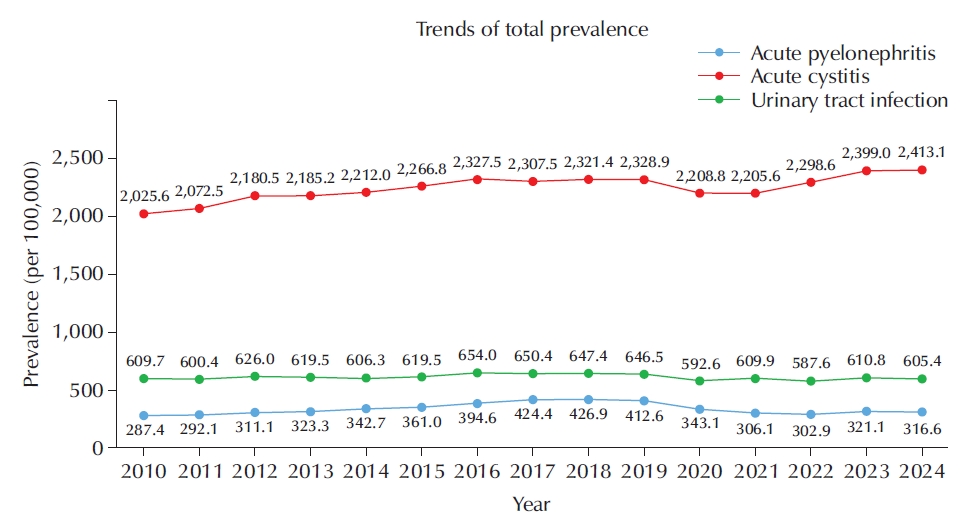
This study aims to investigate the long-term prevalence trends and epidemiological characteristics of acute pyelonephritis (APN), acute cystitis (AC), and other urinary tract infections (UTIs) in South Korea using nationwide big data. Materials and Methods: Data for ICD-10 (International Classification of Diseases, Tenth Revision) codes N10.0 (APN), N30.0 (AC), and N39.0 (UTI) were extracted from the Health Insurance Review and Assessment Service database from 2010 to 2024. Annual prevalence per 100,000 persons, sex and age-specific distribution, regional variations, and hospitalization/outpatient patterns were analyzed.
Results
The average annual prevalence per 100,000 was 344.4 for APN, 2,250.2 for AC, and 619.1 for UTI. AC reached its highest prevalence in 2024, despite a temporary decline in 2020. All conditions were more prevalent in females, with AC showing the highest male-to-female ratio of 1:20.4. A sharp 3.06-fold increase in APN prevalence was observed in females transitioning from ages 15–19 to 20–24 age group. Conversely, males showed a significant prevalence jump (1.43-fold) after age 80. In regional analysis, Gangwon State (469.5) and Jeju Special Self-Governing Province (177.9) recorded the highest and lowest APN prevalence, respectively. UTI required the longest hospitalization, while APN stays averaged 9.2 days for males and 9.0 days for females. An increase in related healthcare costs was also identified.
Conclusions
Age and sex are critical determinants of UTI epidemiology. The distinct spike in young females suggests a link to sexual activity, while the surge in elderly males likely correlates with prostatic conditions. These findings provide essential data for establishing targeted public health policies and clinical guidelines.
- 492 View
- 11 Download

Review Article
- Adult Syphilis: A Narrative Review of Clinical Insights and Public Health Implications in Urology
- Seung-Ju Lee, Jin Bong Choi
- Urogenit Tract Infect 2025;20(3):123-131. Published online December 31, 2025
- DOI: https://doi.org/10.14777/uti.2550039017
-
Abstract
PDFPubReaderePub
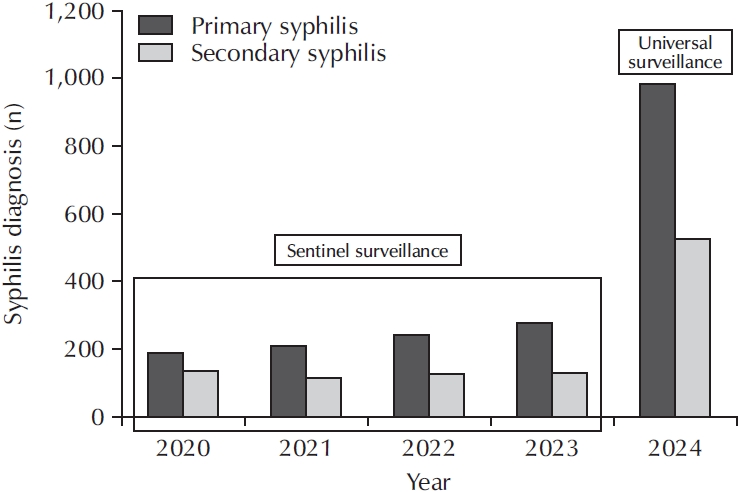
- Syphilis continues to pose a major global public health concern, with more than 7 million cases reported worldwide in 2022, and its incidence continues to rise in numerous regions. In Korea, the shift from sentinel to universal notification in 2024 has revealed a markedly greater disease burden, particularly among men who have sex with men and among younger adults, underscoring changing epidemiological patterns and the urgent need for revised control strategies. In urological practice, syphilis presents with a wide range of often misleading symptoms, including painless genital ulcers, urethritis, and sexual dysfunction, that frequently resemble other genitourinary disorders and complicate diagnostic evaluation. Accurate identification relies on integrating a thorough clinical assessment with serologic testing while remaining alert to diagnostic challenges such as early latent infection, serofast states, and human immunodeficiency virus coinfection. Penicillin G remains the mainstay of therapy, with treatment regimens tailored to the stage of disease and to the presence or absence of central nervous system involvement. Effective partner notification, targeted screening, and consistent follow-up are essential to prevent reinfection and limit further transmission. At a public health level, a multifaceted strategy—strengthened surveillance systems, focused testing in high-risk populations, and embedding syphilis screening within broader sexually transmitted infection care frameworks—is critical to curbing its resurgence. In summary, prompt recognition, adherence to evidence-based management, and coordinated public health measures, together with ongoing advances in diagnostics and prevention, remain fundamental to reducing the continued spread of syphilis and mitigating its impact on both individual and population health.
-
Citations
Citations to this article as recorded by
- Case Report: Secondary syphilis with pulmonary involvement mimicking eosinophilic granulomatosis with polyangiitis — targeted next-generation sequencing as an adjunct in resolving an atypical non-exanthematous presentation
Shunjun Tang, Tiehan Zhang, Aiyi Hao, Bin Su, Bin Liu
Frontiers in Medicine.2026;[Epub] CrossRef
- Case Report: Secondary syphilis with pulmonary involvement mimicking eosinophilic granulomatosis with polyangiitis — targeted next-generation sequencing as an adjunct in resolving an atypical non-exanthematous presentation
- 3,621 View
- 71 Download
- 1 Crossref
Original Article
- Trends in Age-Specific Prevalence of Lower Urinary Tract Dysfunction: A Nationwide Population-Based Cohort Study
- Young Hwan Kim, Se Hwa Hong, Tae Wook Kang, Hyun Chul Chung, Tae Hyoung Kim, Sae Chul Kim, Sang Baek Koh, Jae Hung Jung
- Urogenit Tract Infect 2023;18(3):101-106. Published online December 31, 2023
- DOI: https://doi.org/10.14777/uti.2023.18.3.101
-
Abstract
PDF
 Supplementary MaterialPubReaderePub
 - Purpose: To elucidate the longitudinal changes in the prevalence of lower urinary tract dysfunction (LUTD) according to age over the past 10 years.
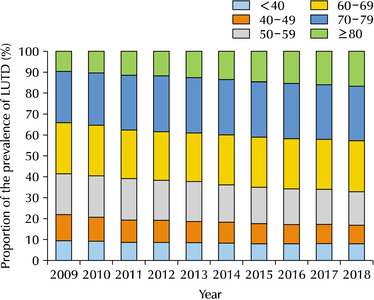
Materials and Methods: The changes in the proportion of prevalence for LUTD, including benign prostatic hyperplasia (BPH) and urinary incontinence (UI) among South Koreans from 2009 to 2018, were analyzed using the National Health Information Database established by the Korean National Health Insurance Service. All conditions were defined according to the corresponding Korean Standard Classification of Diseases-8 for diagnosis and surgical procedures and Health Insurance Review & Assessment Service codes for drugs.
Results: The 60-69, 70-79, and over 80 age groups accounted for more than 60% of the LUTD cases from 2009 to 2018, while significant increases in the crude prevalence of LUTD were observed over a 10-year period in all age groups (p for trend <0.05). In age groups over 60 years, LUTD was more prevalent in men than women, but there was no statistically significant difference in proportion (p>0.05). The changes in the prevalence and prevalence proportion exhibited similar trends in BPH, UI, and LUTD.
Conclusions: LUTD was more prevalent in the elderly aged over 60 years old than in younger adults. Therefore, this study suggests the development of nationwide healthcare policies to manage LUTD in the elderly population of South Korea, which is expected to become the world’s most aged population. -
Citations
Citations to this article as recorded by- Nursing strategies for managing urological disorders in aging populations: a comprehensive review
Hong Liu, Jie Wu
BMC Urology.2026;[Epub] CrossRef
- Nursing strategies for managing urological disorders in aging populations: a comprehensive review
- 7,000 View
- 34 Download
- 1 Crossref
 First
First Prev
Prev


