



Search
- Page Path
- HOME > Search
Review Article
- Antibiotic Prophylaxis for Transrectal Prostate Biopsy
- Do Gyeong Lim, Seung Il Jung
- Urogenit Tract Infect 2026;21(2):47-55. Published online August 31, 2026
- DOI: https://doi.org/10.14777/uti.2652012.006
-
 Abstract
 PDF
PDF PubReader
 ePub
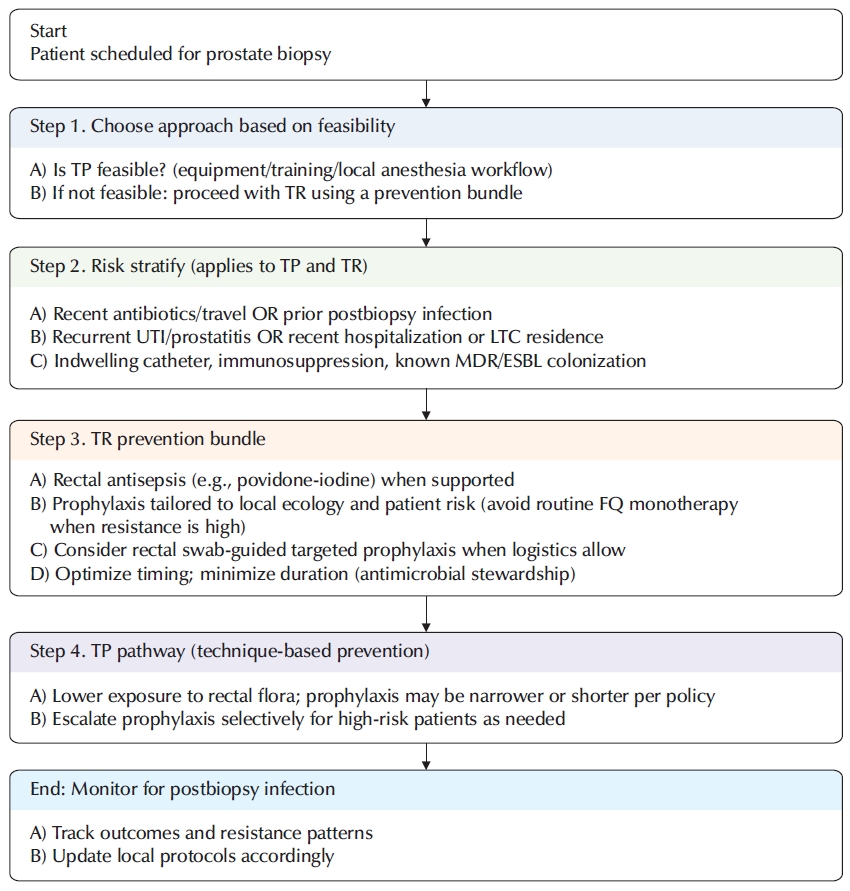
ePub - Transrectal prostate biopsy (TRPB) is widely used for the diagnosis of prostate cancer but carries a clinically meaningful risk of infectious complications due to inoculation and translocation of rectal flora into the urinary tract and bloodstream. Antibiotic prophylaxis remains central to preventing febrile urinary tract infection and sepsis; however, increasing antimicrobial resistance—particularly fluoroquinolone-resistant Enterobacterales—has reduced the reliability of conventional empirical regimens in many regions. In this narrative review, we searched PubMed/MEDLINE, Embase, and Scopus for relevant literature published through February 2026 and synthesized current guideline positions and selected clinical evidence on prophylactic regimens, resistance-adapted regimen selection, and adjunctive measures for TRPB. Cumulative evidence indicates that the efficacy of fluoroquinolone monotherapy has significantly declined in regions with high-resistance prevalence. Alternative or augmented strategies (e.g., cephalosporin- or fosfomycin-based approaches) may reduce infectious complications in selected settings, although their performance appears context-dependent and may be accompanied by shifts in pathogen distribution. Rectal swab-guided targeted prophylaxis can individualize antibiotic selection; however, its effectiveness varies across studies because of methodological heterogeneity and imperfect prediction of clinical outcomes. Technique-based prevention, most notably transperineal biopsy, may reduce infectious risk while decreasing reliance on broad-spectrum prophylaxis. Taken together, infection prevention after prostate biopsy should be individualized according to local susceptibility patterns and patient-level risk while integrating antimicrobial stewardship and selecting adjunctive or technique-based measures when feasible.
- 625 View
- 11 Download

Original Article
- Korean Multicenter Study of Infectious Complications after Transurethral Prostate Surgery in Patients with Preoperative Sterile Urine
- Seong Hyeon Yu, Seung Il Jung, Eu Chang Hwang, Tae-Hyoung Kim, Jae Duck Choi, Koo Han Yoo, Jeong Woo Lee, Dong Hoon Koh, Sangrak Bae, Seung Ok Yang, Joongwon Choi, Seung Ki Min, Hoon Choi
- Urogenit Tract Infect 2022;17(3):81-88. Published online December 31, 2022
- DOI: https://doi.org/10.14777/uti.2022.17.3.81
-
Abstract
PDFPubReaderePub
- Purpose: To evaluate the efficacy of antibiotic prophylaxis and determine the risk factors of infectious complications after transurethral surgery of the prostate.
Materials and Methods: Seven hundred and seventy-two patients who underwent transurethral resection of the prostate (TURP) or holmium laser enucleation of the prostate (HOLEP) were reviewed. Of these, this study enrolled 643 patients without bacteriuria who had not received antibiotics for urinary tract infections for two weeks before surgery. The patients were divided into two groups according to the duration of the antibiotics (Group 1: less than one day, n=396 vs. Group 2: more than one day, n=247).
Results: The overall incidence of postoperative infectious complications in 643 patients was 5.0% (32/643). When postoperative infectious complications were compared according to the duration of the antibiotics (Group 1 vs. Group 2), the infectious complications rates were 5.6% (22/396) vs. 4.0% (10/247), respectively (p=0.393). When postoperative infectious complications were compared according to the duration of antibiotics (Group 1 vs. Group 2) in the TURP and HOLEP groups, the infectious complications rates were 6.3% (12/192) vs. 1.0% (1/103) (p=0.035) and 4.9% (10/203) vs. 6.0% (8/134) (p=0.677), respectively. The duration of Foley catheterization was independently associated with infectious complications (p=0.003).
Conclusions: The results showed that prolonged postoperative catheterization affects postoperative infectious complications associated with transurethral prostate surgery. Although antibiotics administered for less than one day are effective for antibiotic prophylaxis of transurethral prostate surgery, a longer antibiotic therapy is recommended for TURP. -
Citations
Citations to this article as recorded by
- Evaluation of Postoperative Urinary Tract Infection and Sepsis Rates After Adding Cystolitholapaxy to HoLEP:
A Retrospective Analysis
Federico Rovegno, Rajiv Pillai, Zafar Maan, Soumendra Datta, Omar Nasir, Gerald Rix
International Journal of Clinical Urology.2026; 10(1): 1. CrossRef - Comparison of HoLEP Outcomes Between Catheterized and Non‐Catheterized Patients: A Propensity Score–Matched Analysis
Caglar Dizdaroglu, Ufuk Caglar, Arda Meric, Cagri Yaman, Faruk Ozgor, Omer Sarilar
LUTS: Lower Urinary Tract Symptoms.2026;[Epub] CrossRef
- Evaluation of Postoperative Urinary Tract Infection and Sepsis Rates After Adding Cystolitholapaxy to HoLEP:
A Retrospective Analysis
- 7,133 View
- 40 Download
- 2 Crossref
 First
First Prev
Prev


