



Previous issues
- Page Path
- HOME > Browse Articles > Previous issues
- Volume 19 (1); April 2024
-


Editorial
- Male Human Papilloma Virus Infections: How to Prepare for Vaccination Strategies
- Jeonghyouk Choi, Koo Han Yoo
- Urogenit Tract Infect 2024;19(1):1-2. Published online April 30, 2024
- DOI: https://doi.org/10.14777/uti.2024.19.1.1
- 2,867 View
- 18 Download

Original Articles
- Does Music Have a Calming Effect on Pain and Anxiety in Patients Undergoing Cystoscopy?
- Ye Chan Joo, Ji Eun Yu, Jae Hyun Baik, Young Seop Chang, Jin Bum Kim, Hyung Joon Kim, Dong Hoon Koh, Hong Wook Kim
- Urogenit Tract Infect 2024;19(1):3-9. Published online April 30, 2024
- DOI: https://doi.org/10.14777/uti.2024.19.1.3
-
 Abstract
 PDF
PDF Supplementary Material
 PubReader
 ePub
ePub - Purpose: Cystoscopy is a diagnostic test performed frequently in urology outpatient clinics. Despite the large number of inspections, the associated pain, discomfort, or anxiety can markedly affect patient compliance and adherence to subsequent surveillance protocols. This study conducted a prospective, randomized study to investigate the potential efficacy of music and pyuria on pain or anxiety during outpatient cystoscopy.
Materials and Methods: In this single-institution, randomized study, the participants were assigned to a music-intervention or non-music control group. The music-intervention group underwent an identical procedure with the addition of Johann Sebastian Bach’s “Air on the G String” from Suite No. 3 in D major, BWV 1068. Urinalysis was performed to determine if pyuria affects pain during the procedure.
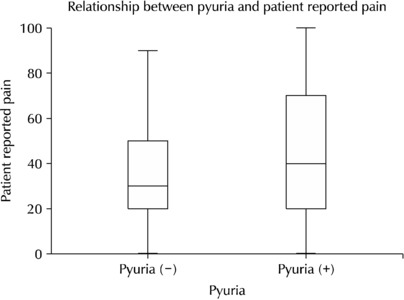
Results: The patient-reported outcomes, encompassing the changes in the STAI-X-1 (State-Trait Anxiety Inventory-X-1) scores, subjective levels of discomfort, embarrassment, satisfaction, and pain, were similar in the two groups. In contrast, the surgeons reported statistically significant differences in their evaluations of the same items as patient-reported outcomes of the two groups. The patient-reported pain showed no significant differences between the pyuria-negative group (0-2 and 3-5 WBC/HPF) and pyuria-positive group (>5 WBC/HPF).
Conclusions: The data from this study do not support the hypothesis that musical intervention during cystoscopy alleviates pain or anxiety to any significant extent. In addition, pyuria did not affect the patient’s reported pain. Nevertheless, a notable impact was observed in the surgeons’ assessments, suggesting that the musical accompaniment may alter the surgeons’ perception of patient pain and anxiety levels throughout the procedure. -
Citations
Citations to this article as recorded by
- Music as a Nonpharmacological Adjunct for Reducing Pain, Anxiety, and Physiological Stress During Cystoscopy: A Systematic Review and Meta-Analysis
Mohamed Abo Zeid, Michael Gerges, Kareem Khalefa, Amira A. Aboali, Ahmed Talkhan, Lamees Taman, Amr M. Abou Elezz
International Urogynecology Journal.2026;[Epub] CrossRef
- Music as a Nonpharmacological Adjunct for Reducing Pain, Anxiety, and Physiological Stress During Cystoscopy: A Systematic Review and Meta-Analysis
- 4,226 View
- 45 Download
- 1 Crossref
- Is Routine Voiding Cystourethrogram Necessary Following Endoscopic Subureteral Injection for Primary Low-Grade Vesicoureteral Reflux?
- Jun-Koo Kang, Min Ji Park, Min Hyun Cho, Jun Nyung Lee
- Urogenit Tract Infect 2024;19(1):10-15. Published online April 30, 2024
- DOI: https://doi.org/10.14777/uti.2024.19.1.10
-
Abstract
PDFPubReaderePub
- Purpose: An endoscopic subureteral injection (EI) using a bulking agent is a highly successful surgical procedure, particularly for low-grade vesicoureteral reflux (VUR). Despite the serious adverse effects, routine voiding cystourethrogram (VCUG) to determine radiographic success after EI remains controversial. This study evaluated the necessity of routine postoperative VCUG in children with primary low-grade VUR.
Materials and Methods: From January 2016 to August 2021, children who underwent EI for primary low-grade (I-III) VUR with a history of febrile urinary tract infection (fUTI) were analyzed retrospectively. From January 2016 to July 2018, routine VCUG following EI was performed on all children. Thereafter, postoperative VCUG was performed only if indicated. Clinical success was defined as no fUTI during a 12-month follow-up, and radiographic success was defined as the disappearance of VUR on postoperative VCUG. The clinical and radiographic outcomes in both groups were compared.
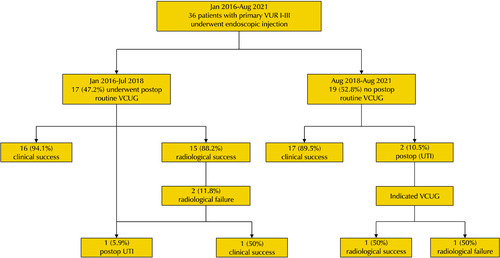
Results: Thirty-six children were analyzed in this study. Three children (8.3%) experienced postoperative fUTI. In the routine group, clinical and radiographic success was observed in 16/17 (94.1%) and 15/17 (88.2%), respectively. Two children in the routine group experienced radiographic failure. Among these, one child showed clinical success, and the other underwent additional EI due to clinical failure. Of the indicated group, clinical failure was observed in 2/19 (10.5%). Of them, persistent VUR was identified in one child.
Conclusions: Clinical and radiologic success after EI for primary low-grade VUR is high, and routine VCUG for confirming radiographic success has a limited impact on the clinical course.
- 2,347 View
- 17 Download
- Pelvic Pain in Men with Mycoplasma Genitalium
- Yumi Seo
- Urogenit Tract Infect 2024;19(1):16-23. Published online April 30, 2024
- DOI: https://doi.org/10.14777/uti.2024.19.1.16
-
Abstract
PDFPubReaderePub
- Purpose: There are debates about Mycoplasma genitalium (M. genitalium) causing prostate infection and inducing pelvic pains. Consequently, M. genitalium-associated pelvic pains were characterized and their manifestation in male pelvic pain syndrome (MPPS) was evaluated through a case-control study.
Materials and Methods: The presence of M. genitalium-associated pelvic pains was examined in 113 M. genitalium-infected men, and the typical presentations of mycoplasma-associated MPPS were characterized through a case-control study involving 80 mycoplasma-infected and 234 case-matched uninfected controls. Finally, changes in symptoms following antimicrobial treatments were compared between 27 cured and 14 persistently infected cases.
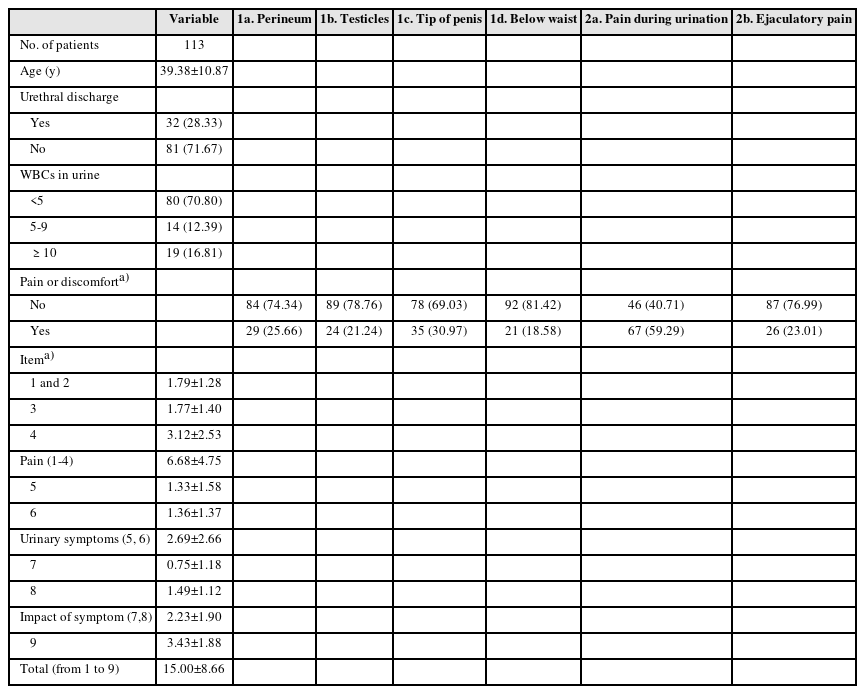
Results: Pain locations from 113 men were followed as items-1a for 25.7%, 1b for 21.2%, 1c for 31%, 1d for 18.6%, 2a for 59.3%, and 2b for 23% from the Korean National Institutes of Health-Chronic Prostatitis Symptom Index (NIH-CPSI) questionnaire. In addition, the sum scores from the pain domain, voiding domain and total score were 6.68±4.75, 2.69±2.66, and 15.00±8.66, respectively. Successful antibiotic therapy significantly reduced the total score from baseline (15.148±6.798 vs. 5.357±7.025, p=0.001). From the case-control study, mycoplasma-infected men had pains more frequently during urination (1c) and on the tip of the penis (2a) (all p=0.0001) than the controls.
Conclusions: It was found that M. genitalium infection is associated with clinically significant male pelvic pains, which improved with adequate antimicrobial therapies. Urethral irritation symptoms without pyuria may be the typical characteristics of mycoplasma-associated pelvic pains in MPPS.
- 12,473 View
- 41 Download
 First
First Prev
Prev


