-
Intraoperative Factors Associated With Postoperative Febrile Infectious Complications Following Retrograde Intrarenal Surgery: A Propensity Score-Matched Study
-
Wonjong Yang, Sangyong Park, Hee Sub Lee, Youngrak Jeong, Wonchul Lee, Hyung-Jee Kim, Seong Ho Lee, Justin Lee, Jong Keun Kim
-
Urogenit Tract Infect 2026;21(2):125-135. Published online August 31, 2026
-
DOI: https://doi.org/10.14777/uti.2652028.014
-
-
 Abstract Abstract
 PDF PDF
- Purpose
To investigate the intraoperative factors associated with postoperative febrile infectious complications following retrograde intrarenal surgery (RIRS).
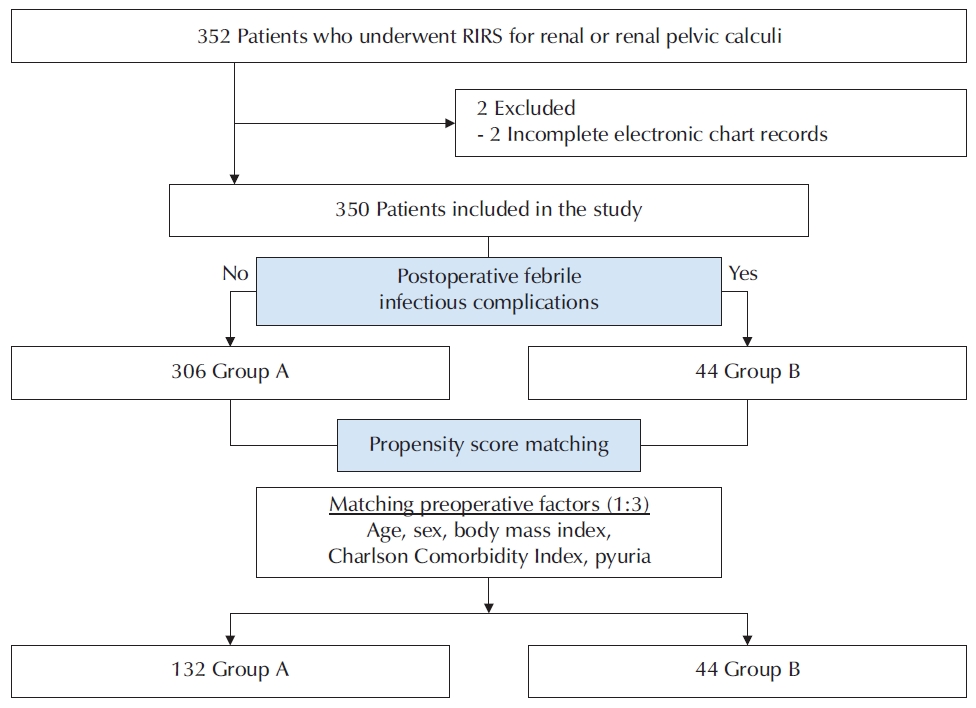
Materials and Methods: A total of 352 patients who underwent RIRS for renal stones between March 2017 and December 2022 were included in the analysis. Preoperative factors included age, sex, body mass index, underlying diseases, preoperative urine analysis results, and stone characteristics on computed tomography scans. Patients were divided into 2 groups based on the presence (group B) or absence (group A) of postoperative febrile infectious complications. Intraoperative factors—such as the degree of hydronephrosis on retrograde pyelography (RGP), stone impaction on endoscopic findings, size of the ureteral access sheath (UAS), grade of ureteral wall injury, operation time, and stone composition—were compared retrospectively.
Results
Postoperative febrile infectious complications occurred in 44 patients (12.6%). Following 1:3 propensity score matching, preoperative factors were analyzed for 44 patients (group B) and 132 patients (group A). Group B had a significantly longer hospital stay than group A (p=0.007); however, no significant differences were observed in postoperative pain (p=0.862) or stone-free rate (p=0.197). Hydronephrosis (odds ratio [OR], 7.31; 95% confidence interval [CI], 2.65–20.19) and high-grade ureteral wall injury (OR, 4.15; 95% CI, 1.88–9.12) were independently associated with postoperative febrile infectious complications, whereas no significant associations were observed for stone impaction, UAS size, operation time, or infectious stone composition.
Conclusions
Hydronephrosis identified on RGP and high-grade ureteral wall injury during RIRS were associated with postoperative febrile infectious complications and may serve as potential markers for risk stratification.
-
Purple Urine Bag Syndrome
-
Woo Seok Choi, Seyung Kim, Jae Rock Oh, Seong Ho Lee, Chong Wook Lee, Sang Kon Lee
-
Korean J Urogenit Tract Infect Inflamm 2009;4(2):228-231. Published online October 31, 2009
-
-
-
Abstract
- Purple urine bag syndrome is a rare condition in which the urinary drainage bag turns purple. It occurs predominantly in chronically catheterized women and associated with urinary tract infections. Herein, 3 cases of purple urine bag syndromes are reported in 1 elderly man and 2 elderly women.
|