-
Acute Obstructive Pyelonephritis With Bilateral Hutch Diverticula in an Adult: A Case Report
-
Kyu Hyoung Cho, Gilho Lee, Youn Soo Jeon
-
Urogenit Tract Infect 2026;21(2):136-139. Published online August 31, 2026
-
DOI: https://doi.org/10.14777/uti.2652024.012
-
-
 Abstract Abstract
 PDF PDF
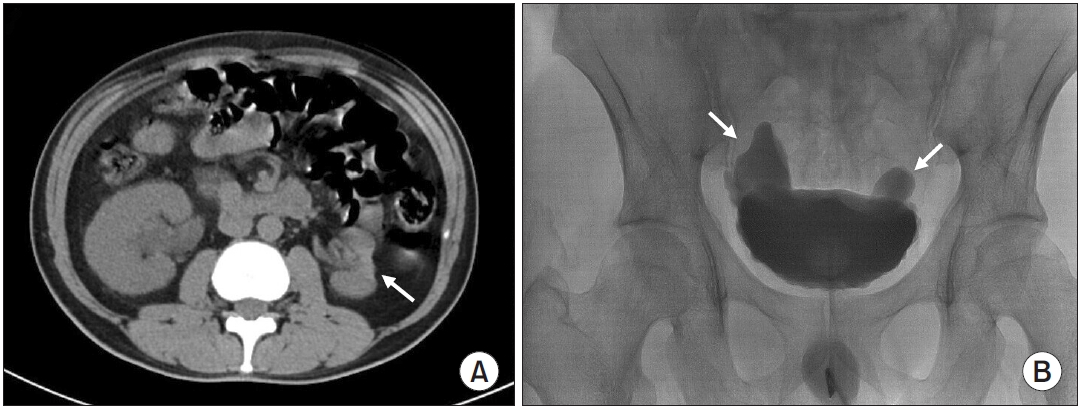
- Hutch diverticula are congenital bladder diverticula arising at the ureterovesical junction, typically associated with pediatric vesicoureteral reflux (VUR). Acute obstructive pyelonephritis occurring in an adult with bilateral Hutch diverticula is rare. The presence of a periureteral diverticulum may complicate ureteral stent placement and interpretation of postprocedural imaging findings. We report a 39-year-old man who was diagnosed with bilateral Hutch diverticula while being treated for acute obstructive pyelonephritis caused by a 4-mm proximal right ureteral stone. Following urgent right ureteral stenting and antimicrobial therapy, the patient's symptoms resolved, and he was discharged after 10 days of hospitalization. A subsequent voiding cystourethrogram confirmed bilateral Hutch diverticula but did not demonstrate definitive VUR. The imaging and cystoscopic findings clearly demonstrated the anatomical relationship between the right ureteral orifice and the adjacent right diverticulum. In addition, the distal coil of the double-J stent was lodged within the diverticulum, mimicking upward migration of the stent on kidney-ureter-bladder radiography. This case highlights a technical and radiologic pitfall of ureteral stenting in a patient with bilateral Hutch diverticula and emphasizes the importance of careful anatomical assessment during endourological intervention.
-
Recent Antimicrobial Susceptibilities for Uropathogenic Escherichia coli in Patients with Community Acquired Urinary Tract Infections: A Multicenter Study
-
Woong Bin Kim, Kyu Hyoung Cho, Sang Wook Lee, Hee Jo Yang, Jong Hyun Yun, Kwang Woo Lee, Jun Mo Kim, Young Ho Kim, Youn Soo Jeon, Min Eui Kim
-
Urogenit Tract Infect 2017;12(1):28-34. Published online April 30, 2017
-
-
-
Abstract
PDF
- Purpose: The aim of this study was to determine the prevalence and disease-specific antimicrobial susceptibility of Escherichia coli in urinary tract infections (UTIs).
Materials and Methods: A total of 862 patients older than 18 years of age, who were diagnosed with UTI between January 2013 and December 2015, were included. The results of urine culture, prevalence of extended-spectrum beta lactamase (ESBL)-producing E. coli, and antimicrobial susceptibility by disease were also examined.
Results: A total of 862 uropathogens were isolated. Among then, E. coli accounted for 756 (87.7%) isolates. The susceptibility rates of E. coli to the following antimicrobial agents were as follows: ampicillin 29.4%, cefazolin 70.5%, ceftazidime 75.1%, cefotaxime 75.0%, cefepime 76.2%, cefoxitin 88.8%, amoxicillin-clavulanic acid 63.6%, trimethoprim-sulfamethoxazole 60.6%, gentamicin 71.4%, ciprofloxacin 73.0%, piperacillin/tazobactam 93.9%, amikacin 99.2%, imipenem 99.1%, and ertapenem 99.3%. The frequency of ESBL-producing E. coli strains was 24.6%. The antimicrobial susceptibility of UTI varied by each disease, but without statistical significance.
Conclusions: It is necessary to regularly examine the disease-specific resistance rates to determine the appropriate empiric antibiotic treatment, and the national antibiotic usage policies must be reorganized according to the data obtained from these studies.
|