-
Intraoperative Factors Associated With Postoperative Febrile Infectious Complications Following Retrograde Intrarenal Surgery: A Propensity Score-Matched Study
-
Wonjong Yang, Sangyong Park, Hee Sub Lee, Youngrak Jeong, Wonchul Lee, Hyung-Jee Kim, Seong Ho Lee, Justin Lee, Jong Keun Kim
-
Urogenit Tract Infect 2026;21(2):125-135. Published online August 31, 2026
-
DOI: https://doi.org/10.14777/uti.2652028.014
-
-
 Abstract Abstract
 PDF PDF
- Purpose
To investigate the intraoperative factors associated with postoperative febrile infectious complications following retrograde intrarenal surgery (RIRS).
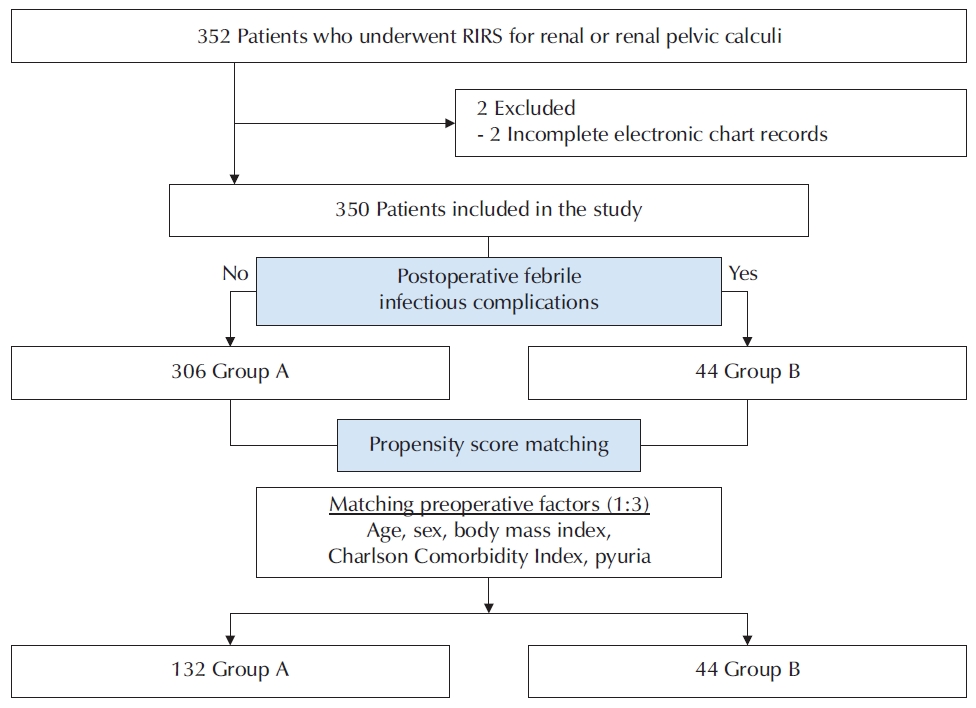
Materials and Methods: A total of 352 patients who underwent RIRS for renal stones between March 2017 and December 2022 were included in the analysis. Preoperative factors included age, sex, body mass index, underlying diseases, preoperative urine analysis results, and stone characteristics on computed tomography scans. Patients were divided into 2 groups based on the presence (group B) or absence (group A) of postoperative febrile infectious complications. Intraoperative factors—such as the degree of hydronephrosis on retrograde pyelography (RGP), stone impaction on endoscopic findings, size of the ureteral access sheath (UAS), grade of ureteral wall injury, operation time, and stone composition—were compared retrospectively.
Results
Postoperative febrile infectious complications occurred in 44 patients (12.6%). Following 1:3 propensity score matching, preoperative factors were analyzed for 44 patients (group B) and 132 patients (group A). Group B had a significantly longer hospital stay than group A (p=0.007); however, no significant differences were observed in postoperative pain (p=0.862) or stone-free rate (p=0.197). Hydronephrosis (odds ratio [OR], 7.31; 95% confidence interval [CI], 2.65–20.19) and high-grade ureteral wall injury (OR, 4.15; 95% CI, 1.88–9.12) were independently associated with postoperative febrile infectious complications, whereas no significant associations were observed for stone impaction, UAS size, operation time, or infectious stone composition.
Conclusions
Hydronephrosis identified on RGP and high-grade ureteral wall injury during RIRS were associated with postoperative febrile infectious complications and may serve as potential markers for risk stratification.
-
Exploring National Trends in Bladder-Related Urological Procedures: A Nationwide Population-Based Cohort Study
-
Hyosang Kwon, Wonjong Yang, Sangyong Park, Heesub Lee, Jong Keun Kim, Jun Hyun Han
-
Urogenit Tract Infect 2023;18(2):50-59. Published online August 31, 2023
-
DOI: https://doi.org/10.14777/uti.2023.18.2.50
-
-
Abstract
PDF
 PubReader PubReader ePub ePub
- Purpose: This study examined the epidemiological trends of bladder-related urological procedures in South Korea from 2009 to 2021.
Materials and Methods: The data were obtained from the Health Insurance Review and Assessment Service (HIRA) database, encompassing various bladder-related urological procedures. The frequencies and trends were analyzed using statistical methods.
Results: Uroflowmetry, cystoscopy, prostate biopsy, and urethral dilation showed a positive trend, while prostate massage exhibited a negative trend. The 72-hour voiding function test, which started in 2017, also demonstrated a positive trend in frequency. A urodynamic study and mid-urethral sling operation exhibited an overall decreasing trend. Bladder-indwelling catheter, Nelaton catheterization, and cystostomy catheter change showed increasing trends, while suprapubic cystostomy showed a decreasing trend.
Conclusions: This 12-year analysis provided valuable insights into the epidemiological patterns and utilization of bladder-related urological procedures in South Korea. These trends highlight the evolving landscape of diagnostic and therapeutic approaches in bladder-related conditions and the importance of interdisciplinary collaboration between urology and other medical departments. The results highlight the need for optimizing catheter-related care protocols, resource allocation, and continued monitoring of practices across healthcare settings.
|