-
Efficacy of D-Mannose in the Management of Urinary Tract Infections: From Acute Treatment to Long-term Prophylaxis — A Systematic Review and Meta-analysis
-
Jae Yong Jeong, Young Joon Moon, Dong Hyuk Kang, Hae Do Jung, Lawrence Kim, Joo Yong Lee
-
Urogenit Tract Infect 2026;21(2):111-124. Published online August 31, 2026
-
DOI: https://doi.org/10.14777/uti.2652010.005
-
-
 Abstract Abstract
 PDF PDF
- Purpose
To evaluate the efficacy of D-mannose for preventing recurrent urinary tract infections (UTIs), including in kidney transplant recipients, and to clarify discrepancies between early openlabel and placebo-controlled trials.
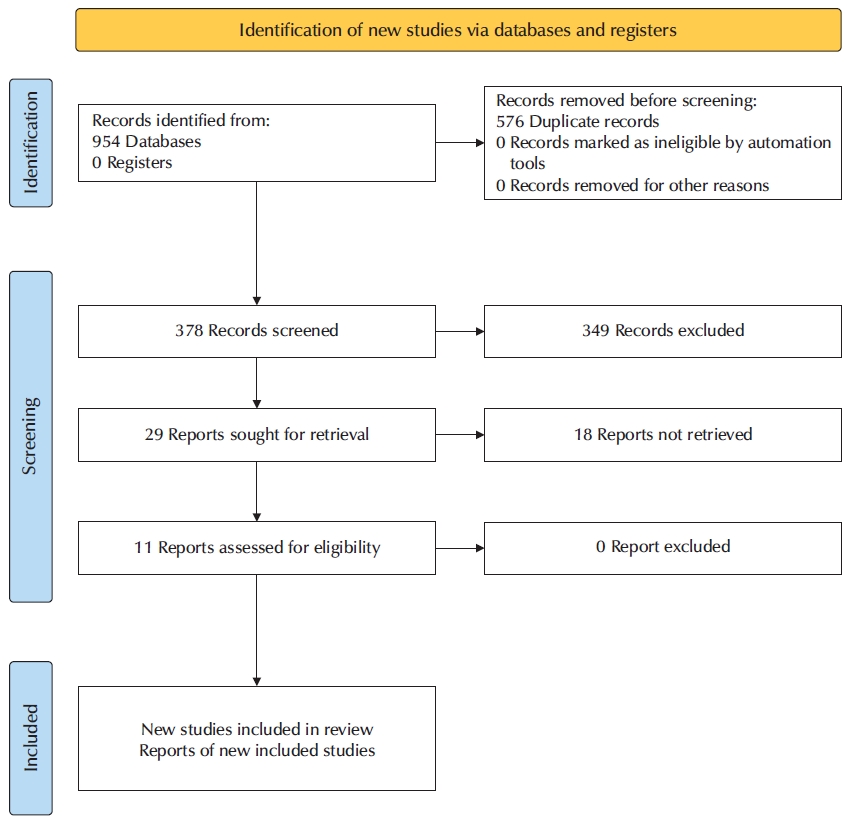
Materials and Methods: PubMed, Embase, CENTRAL (Cochrane Central Register of Controlled Trials), and Web of Science were searched from inception to February 2026. Randomized controlled trials (RCTs) comparing D-mannose with placebo, no treatment, antibiotics, or active controls were included. Risk of bias (RoB) was assessed using RoB 2, and certainty of evidence using GRADE (Grading of Recommendations, Assessment, Development, and Evaluations).
Results
Eleven RCT reports involving 1,724 participants were included; 10 independent study populations involving 1,631 participants contributed to quantitative analyses. In placebo-controlled trials, D-mannose did not significantly reduce UTI recurrence or persistence versus placebo (risk ratio [RR], 0.38; 95% confidence interval [CI], 0.06–2.36). No-treatment comparisons showed reduced recurrence (RR, 0.23; 95% CI, 0.08–0.66), but were more vulnerable to expectation, performance, and detection biases. The exploratory combined estimate favored D-mannose (RR, 0.28; 95% CI, 0.12–0.66), but certainty was very low. Antibiotic comparisons were inconclusive (RR, 0.43; 95% CI, 0.18–1.05), whereas proanthocyanidins active-control comparisons favored D-mannose-containing regimens (RR, 0.57; 95% CI, 0.40–0.82), including data from kidney transplant recipients.
Conclusions
Current placebo-controlled evidence does not establish superiority of D-mannose over placebo. Apparent benefits were mainly driven by no-treatment comparisons with very low certainty. D-mannose remains biologically plausible but clinically uncertain; adequately powered, double-blind, placebo-controlled trials are needed before firm recommendations can be made.
-
Why Should You Care About Oral Gonorrhea and Oral Human Papillomavirus Infection?
-
Jae Yong Jeong, Seok Cho, Hae Do Jung
-
Urogenit Tract Infect 2023;18(1):20-23. Published online April 30, 2023
-
DOI: https://doi.org/10.14777/uti.2023.18.1.20
-
-
Abstract
PDF
 PubReader PubReader ePub ePub
- The incidence of sexually transmitted diseases is increasing with the open-sex culture and as people are having sex at a younger age. Consequently, oral gonorrhea and oral human papillomavirus infections, which are often asymptomatic, result in a high risk of transmission. Oral gonorrhea is symptomatic in less than 20% of patients confirmed by culture for Neisseria gonorrhoeae in both men and women. Even if symptoms develop and oral gonorrhea is diagnosed and treated, the cure rate is less than 90%. Hence, oral gonorrhea can lead to antibiotic resistance to gonorrhea. Oral human papillomavirus infections have received more attention because oral human papillomavirus infections play an important role in the development of oropharyngeal cancer. On the other hand, no test for diagnosing human papillomavirus in the oral cavity has been approved by the US Food and Drug Administration. This lack of test makes it difficult to detect oral human papillomavirus infection early, which can further increase the risk of transmission of human papillomavirus infections. Preventing human papillomavirus infections is very important because surgical resection is the only treatment. Vaccination against human papillomavirus-associated oropharyngeal cancers, including tonsil cancer and base of the tongue cancer, has been reported to be effective in reducing the prevalence of oral human papillomavirus infection in middle-aged adults. Human papillomavirus vaccination is essential for protecting against oral human papillomavirus infection.
|