-
Intraoperative Factors Associated With Postoperative Febrile Infectious Complications Following Retrograde Intrarenal Surgery: A Propensity Score-Matched Study
-
Wonjong Yang, Sangyong Park, Hee Sub Lee, Youngrak Jeong, Wonchul Lee, Hyung-Jee Kim, Seong Ho Lee, Justin Lee, Jong Keun Kim
-
Urogenit Tract Infect 2026;21(2):125-135. Published online August 31, 2026
-
DOI: https://doi.org/10.14777/uti.2652028.014
-
-
 Abstract Abstract
 PDF PDF
- Purpose
To investigate the intraoperative factors associated with postoperative febrile infectious complications following retrograde intrarenal surgery (RIRS).
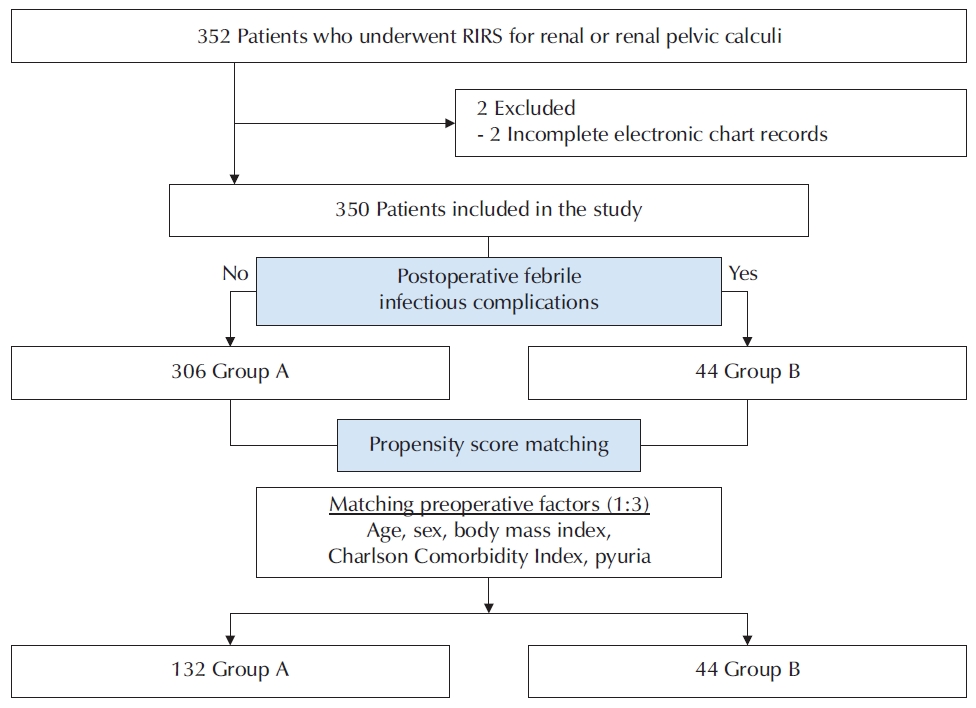
Materials and Methods: A total of 352 patients who underwent RIRS for renal stones between March 2017 and December 2022 were included in the analysis. Preoperative factors included age, sex, body mass index, underlying diseases, preoperative urine analysis results, and stone characteristics on computed tomography scans. Patients were divided into 2 groups based on the presence (group B) or absence (group A) of postoperative febrile infectious complications. Intraoperative factors—such as the degree of hydronephrosis on retrograde pyelography (RGP), stone impaction on endoscopic findings, size of the ureteral access sheath (UAS), grade of ureteral wall injury, operation time, and stone composition—were compared retrospectively.
Results
Postoperative febrile infectious complications occurred in 44 patients (12.6%). Following 1:3 propensity score matching, preoperative factors were analyzed for 44 patients (group B) and 132 patients (group A). Group B had a significantly longer hospital stay than group A (p=0.007); however, no significant differences were observed in postoperative pain (p=0.862) or stone-free rate (p=0.197). Hydronephrosis (odds ratio [OR], 7.31; 95% confidence interval [CI], 2.65–20.19) and high-grade ureteral wall injury (OR, 4.15; 95% CI, 1.88–9.12) were independently associated with postoperative febrile infectious complications, whereas no significant associations were observed for stone impaction, UAS size, operation time, or infectious stone composition.
Conclusions
Hydronephrosis identified on RGP and high-grade ureteral wall injury during RIRS were associated with postoperative febrile infectious complications and may serve as potential markers for risk stratification.
-
Effect of Alpha-Blockers on Patients with Benign Prostatic Hyperplasia with Inflammatory Cells in the Prostatic Fluid
-
Yu-Mi Seo, Hyung-Jee Kim
-
Urogenit Tract Infect 2018;13(2):40-44. Published online August 31, 2018
-
-
-
Abstract
PDF
- Purpose: To determine if alpha-blocker monotherapy is effective on patients with benign prostatic hyperplasia (BPH) and prostatic inflammation.
Materials and Methods: Patients who were admitted for the treatment of lower urinary tract symptoms for 18 months were enrolled in this study. All were subjected to an International Prostate Symptom Score (IPSS) evaluation, prostate specific antigen analysis, urinalysis, residual urine testing, prostate massage, and transrectal prostate ultrasonography. The presence of inflammation in the secretion after the prostate massage was observed at high magnification. Patients with a leukocyte count of more than 15 were diagnosed as positive and classified as group 1 (experimental group), whereas those with a leukocyte count of less than 15 were diagnosed as negative and classified as group 2 (control group). Silodosin was administered (4 mg twice a day for two months).
Results: Group 1: After one and two months, there was no significant difference in the maximum urinary flow rate (Qmax) and post-void residual volume (PVR) compared to the baseline. The total IPSS was significantly improved over the 8-week study period. All symptoms except for Qmax and PVR showed significant improvement in the second month. Group 2: After one and two months, significant improvement was observed in all domains of the IPSS, and Qmax and PVR assessment, except for the PVR at one month.
Conclusions: In patients with BPH who have not been treated properly, other treatments based on prostatitis may be needed in addition to alpha blockers if there is inflammation on expressed secretion of prostate.
|