-
Efficacy of D-Mannose in the Management of Urinary Tract Infections: From Acute Treatment to Long-term Prophylaxis — A Systematic Review and Meta-analysis
-
Jae Yong Jeong, Young Joon Moon, Dong Hyuk Kang, Hae Do Jung, Lawrence Kim, Joo Yong Lee
-
Urogenit Tract Infect 2026;21(2):111-124. Published online August 31, 2026
-
DOI: https://doi.org/10.14777/uti.2652010.005
-
-
 Abstract Abstract
 PDF PDF
- Purpose
To evaluate the efficacy of D-mannose for preventing recurrent urinary tract infections (UTIs), including in kidney transplant recipients, and to clarify discrepancies between early openlabel and placebo-controlled trials.
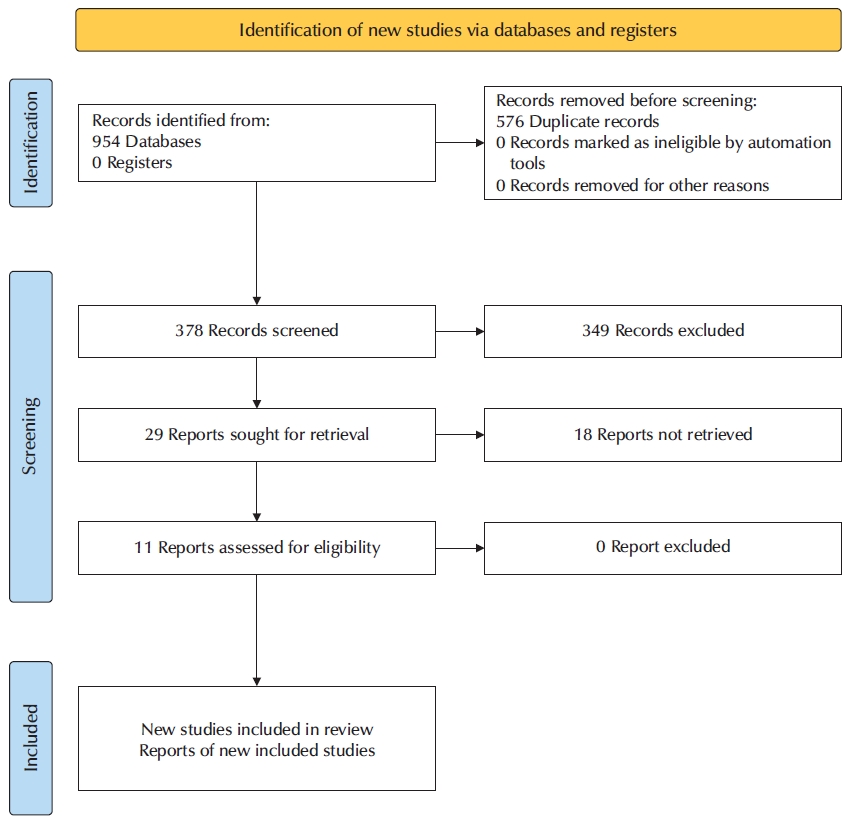
Materials and Methods: PubMed, Embase, CENTRAL (Cochrane Central Register of Controlled Trials), and Web of Science were searched from inception to February 2026. Randomized controlled trials (RCTs) comparing D-mannose with placebo, no treatment, antibiotics, or active controls were included. Risk of bias (RoB) was assessed using RoB 2, and certainty of evidence using GRADE (Grading of Recommendations, Assessment, Development, and Evaluations).
Results
Eleven RCT reports involving 1,724 participants were included; 10 independent study populations involving 1,631 participants contributed to quantitative analyses. In placebo-controlled trials, D-mannose did not significantly reduce UTI recurrence or persistence versus placebo (risk ratio [RR], 0.38; 95% confidence interval [CI], 0.06–2.36). No-treatment comparisons showed reduced recurrence (RR, 0.23; 95% CI, 0.08–0.66), but were more vulnerable to expectation, performance, and detection biases. The exploratory combined estimate favored D-mannose (RR, 0.28; 95% CI, 0.12–0.66), but certainty was very low. Antibiotic comparisons were inconclusive (RR, 0.43; 95% CI, 0.18–1.05), whereas proanthocyanidins active-control comparisons favored D-mannose-containing regimens (RR, 0.57; 95% CI, 0.40–0.82), including data from kidney transplant recipients.
Conclusions
Current placebo-controlled evidence does not establish superiority of D-mannose over placebo. Apparent benefits were mainly driven by no-treatment comparisons with very low certainty. D-mannose remains biologically plausible but clinically uncertain; adequately powered, double-blind, placebo-controlled trials are needed before firm recommendations can be made.
-
Stone-Free Rates of mPCNL, PCNL, and RIRS: A Systematic Review and Network Meta-Analysis
-
Dong Hyuk Kang, Kang Su Cho, Doo Yong Chung, Won Sik Jeong, Hae Do Jung, Do Kyung Kim, Joo Yong Lee
-
Urogenit Tract Infect 2022;17(1):14-25. Published online April 30, 2022
-
DOI: https://doi.org/10.14777/uti.2022.17.1.14
-
-
Abstract
PDF
 PubReader PubReader ePub ePub
- Purpose: Retrograde intrarenal surgery (RIRS) and percutaneous nephrolithotomy (PCNL) are performed to treat renal stones, and miniature PCNL (mPCNL) is used as an alternative to conventional PCNL. We conducted a systematic review of published studies regarding RIRS, PCNL, and mPCNL and performed network meta-analysis on successful outcome (stone-free) rates.
Materials and Methods: The PubMed and EMBASE databases were searched up to December 2020. Data extraction formats were used to extract data on successful outcome rates, study designs, numbers of subjects and characteristics, and methods used to treat renal stones (i.e., RIRS, PCNL, or mPCNL).
Results: Data obtained by 25 studies were used to compare the stone-free rates of RIRS, PCNL, and mPCNL; six comparisons of PCNL and mPCNL, seven of mPCNL and RIRS, and 12 of RIRS and PCNL were analyzed. No difference was found between the stone-free rates of PCNL and mPCNL (odds ratio [OR]: 0.96; 95% confidence interval [CI]: 0.51-1.9) by network meta-analysis. However, the stone-free rate of RIRS was lower than that of mPCNL (OR: 0.41; 95% CI: 0.021-0.82) and PCNL (OR: 0.43; 95% CI: 0.22-0.82). Ranking analysis ranked mPCNL as No. 1 and PCNL as No. 2.
Conclusions: PCNL and mPCNL had better stone-free rates than RIRS for the treatment of renal stones, but the treatment outcomes of PCNL and mPCNL were no different.
-
Citations
Citations to this article as recorded by  - Extraplanar ultrasound-guided multi-tract percutaneous nephrolithotomy: a retrospective comparative study in patients with complex nephrolithiasis
Geng-Geng Wei, Kristine J. S. Kwan, Yu Yang, Qing-Shan Yang, Zhen-Quan Lu, Lin Xiong, Xiang Xu
Frontiers in Urology.2026;[Epub] CrossRef - Outcomes of Percutaneous Nephrolithotomy in Kidney Transplant Recipients: Results from a Multicenter Study by the Spanish Urology Association’s Renal Transplant Group
A. Sierra, H. Alfambra, J. M. López, A. Mercadé, L. L. Peri, R. Espílez, M. Álvarez–Maestro, R. Martínez–Corral, D. A. Pérez-Fentes, B. Etcheverry, S. Colom, F. Vigués, A. Alcaraz, M. P. Luque, C. Torrecilla, M. Musquera
World Journal of Urology.2025;[Epub] CrossRef - Supracostal ultrasound guided approach percutaneous nephrolithotomy (SUGA-PNL) versus retrograde intrarenal surgery for large volume isolated upper calyceal stones: a prospective randomized analysis
Ahmed Assem, Ahmed Abdalla, Mohamed Elzoheiry, Islam Nasser Abd Elaziz, Hesham Amr, Heba Bakr, Ahmed M Rammah
Urolithiasis.2024;[Epub] CrossRef
-
9,681
View
-
89
Download
-
3
Crossref
|