-
Prevalence and Epidemiologic Characteristics of Acute Cystitis, Acute Pyelonephritis and Urinary Tract Infection: Population-Based Analysis Using Health Insurance Review and Assessment Service Bigdata From 2010 to 2024
-
Don Hee Lyu, Jae Chul Lee, Chang Hee Han, Sangrak Bae
-
Urogenit Tract Infect 2026;21(2):96-110. Published online August 31, 2026
-
DOI: https://doi.org/10.14777/uti.2652006.003
-
-
 Abstract Abstract
 PDF PDF PubReader PubReader ePub ePub
- Purpose
This study aims to investigate the long-term prevalence trends and epidemiological characteristics of acute pyelonephritis (APN), acute cystitis (AC), and other urinary tract infections (UTIs) in South Korea using nationwide big data.
Materials and Methods: Data for ICD-10 (International Classification of Diseases, Tenth Revision) codes N10.0 (APN), N30.0 (AC), and N39.0 (UTI) were extracted from the Health Insurance Review and Assessment Service database from 2010 to 2024. Annual prevalence per 100,000 persons, sex and age-specific distribution, regional variations, and hospitalization/outpatient patterns were analyzed.
Results
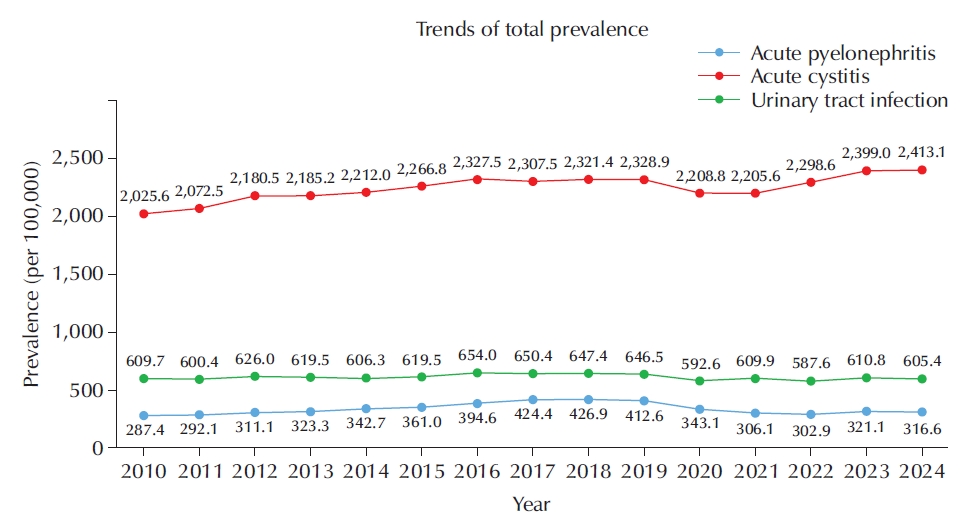
The average annual prevalence per 100,000 was 344.4 for APN, 2,250.2 for AC, and 619.1 for UTI. AC reached its highest prevalence in 2024, despite a temporary decline in 2020. All conditions were more prevalent in females, with AC showing the highest male-to-female ratio of 1:20.4. A sharp 3.06-fold increase in APN prevalence was observed in females transitioning from ages 15–19 to 20–24 age group. Conversely, males showed a significant prevalence jump (1.43-fold) after age 80. In regional analysis, Gangwon State (469.5) and Jeju Special Self-Governing Province (177.9) recorded the highest and lowest APN prevalence, respectively. UTI required the longest hospitalization, while APN stays averaged 9.2 days for males and 9.0 days for females. An increase in related healthcare costs was also identified.
Conclusions
Age and sex are critical determinants of UTI epidemiology. The distinct spike in young females suggests a link to sexual activity, while the surge in elderly males likely correlates with prostatic conditions. These findings provide essential data for establishing targeted public health policies and clinical guidelines.
-
Ureteral Stent Induced Urinary Tract Infection and Microbial Inconsistency Between Bladder and Renal Pelvis
-
Useok Choi, Eun Jae Kim, Don Hee Lyu, Bong Hee Park, Hong Chung, Chang Hee Han, Sangrak Bae
-
Urogenit Tract Infect 2021;16(3):61-66. Published online December 31, 2021
-
DOI: https://doi.org/10.14777/uti.2021.16.3.61
-
-
Abstract
PDFPubReaderePub
- Purpose: This study examined the effects of long-term ureteral stent (US) on urinary tract infection (UTI) by bacterial migration and bacterial colonization.
Materials and Methods: From March 2014 to August 2021, 64 patients who underwent US for more than six months were enrolled in this study. When the US was inserted for the first time and replaced regularly, urine was collected from the bladder and renal pelvis and cultured. Patients’ the characteristics, and differences in pathogens related to US infection were analyzed.
Results: The mean age was 66.4 years, and the mean duration of indwelling was 37.5 months. There were 38 cases (59.3%) by malignant and 26 cases (40.6%) by benign causes. UTI occurred in 33 cases (53%); 16 cases (25%) were hospitalized for febrile UTI. After the initial US insertion, bacteria were identified in the bladder 285 days later and in the renal pelvis after 619 days. The bladder culture was positive in 10 of the 33 patients, and renal pelvis alone was positive in nine of the 33 patients. The same strain was confirmed in the bladder and renal pelvis in 12 cases (18.8%), and it took a mean of 5.8 months ± 6.32 (standard deviation) for the upward migration of bacteria.
Conclusions: UTIs occur in approximately 50% of patients with long-term US indwelling. The probability of culturing the same strain by a US was approximately 18.8%, and the role of pathogen transmission of a US does not appear to be significant. In addition, renal pelvis culture would be helpful in cases of failed bladder antibiotics susceptibility.
-
Citations
Citations to this article as recorded by  - Incidence, risk factors and prognostic impact of pyelonephritis in cancer patients with percutaneous nephrostomy for malignant ureteral obstruction
M. Selman Mert, O. Murat Ipek
Actas Urológicas Españolas (English Edition).2026; : 501993. CrossRef - Incidencia, factores de riesgo e impacto pronóstico de la pielonefritis en pacientes oncológicos con nefrostomía percutánea por obstrucción ureteral maligna
M. Selman Mert, O. Murat Ipek
Actas Urológicas Españolas.2026; : 501993. CrossRef - Urinary Tract Infection with Endoscopic placement of Double J Stent in patients with Hydronephrosis
Ahmed Bilal Ghani, Najam ul Saqib, Syed Faizan Haider, Moin Arshad, Safdar Khan, Sarmad Imtiaz
Journal of Postgraduate Medical Institute.2026;[Epub] CrossRef - Chemical Analysis and Antimicrobial Potential Assessment of Wild Laurel from the National Park Skadar Lake, Montenegro
Dragica Bojović, Miomir Šoškić, Ana Žugić, Marina T. Milenković, Iva Ljumović, Vanja M. Tadić
Applied Sciences.2025; 15(12): 6741. CrossRef - Comprehensive analysis of the bacterial spectrum for enhanced clinical insight in microbial ureteral stent colonization, uncomplicated urinary tract infections and catheter-associated urinary tract infections: a principal component analysis-based literatu
Matilde Lepori, Olivier Braissant, Gernot Bonkat, Malte Rieken
World Journal of Urology.2024;[Epub] CrossRef
-
16,589
View
-
39
Download
-
5
Crossref
|